

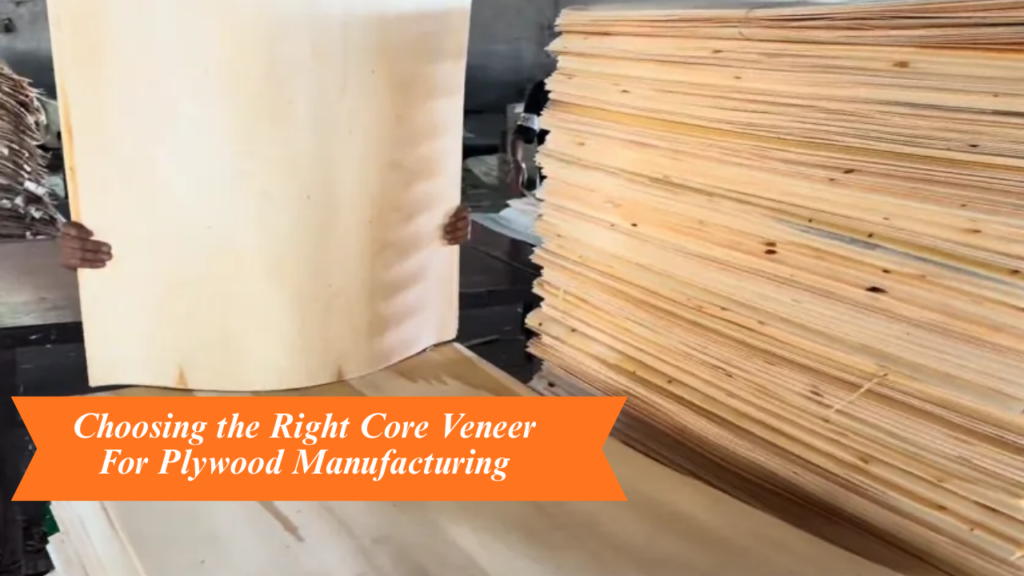
In plywood manufacturing, the face veneer gets attention first. It is visible. It affects appearance. But the core veneer does a different and equally important job. It supports strength, panel balance, screw holding, dimensional stability, and long-term bonding. That is why choosing the right core veneer is not a small factory decision. It affects product quality from the press line to the final customer.
Core veneer choice is shaped by wood species, veneer density, grade, moisture level, thickness consistency, and defects. Manufacturers also need to think about cost, end use, adhesive spread, and pressing conditions. A core that looks acceptable on paper can still create weak bonding, gaps, overlap, or warping if the raw material is not matched to the product target.
This blog explains the decision process. It covers the role of the core, then moves into species choice, grading, density, and bonding behavior. The aim is to show how better plywood core grade selection leads to stronger and more reliable panels.
Why Core Veneer Matters In Plywood
A plywood panel is built from layers of veneer placed with grain direction alternating between adjacent plies. This cross-laminated structure improves stability and helps the panel resist splitting and shape change. The face and back veneers matter most for appearance, but the core layers help determine thickness stability, internal soundness, and bending behavior.
A poor core can create:
- Internal gaps
- Uneven thickness
- Weak bond lines
- Core overlap or open joints
- Reduced panel strength
- More rejection after pressing or sanding
Start with the End Use Before the Raw Material
The first step in plywood core grade selection is not picking a species. It defines the end use.
Ask these questions first:
- Is the plywood meant for furniture, shuttering, interiors, or structural use?
- Is low weight important?
- Will the panel carry heavy loads?
- Will it be used in humid conditions?
- Does the buyer want a very smooth, calibrated panel?
These questions matter because the best core for one product may be the wrong core for another. A light panel may need a lower-density core. A heavy-duty panel may need stronger and denser inner plies. USDA guidance notes that panel properties are influenced by wood species, veneer geometry, adhesive type, and final density.
Understanding Poplar As A Core Material
Poplar is widely used as a plywood core because it is light, workable, and available in veneer form. It is often chosen when manufacturers want lighter boards and easier handling. Industry references place poplar veneer density around 520 kilograms per cubic meter, which helps explain why it is valued for relatively low panel weight.
Knowing poplar veneer density is useful because density affects several production outcomes:
- Panel weight
- Compression during hot pressing
- Nail and screw holding
- Resin absorption behavior
- Machining response
Lower density can help reduce board weight, but it can also require tighter control of veneer quality and glue spread. If the veneer is too loose, too porous, or too uneven, pressing results can suffer.
What Veneer Grade Really Means
Many buyers ask about appearance grades, but core grading is about more than looks. The phrase veneer grade A ” usually refers to a high-quality veneer with very few visible defects and a cleaner, more uniform surface. APA states that A is the highest commonly available veneer grade, with lower grades allowing progressively more defects and repairs.
For core use, the grading question should focus on structure:
- Are there splits?
- Are there open knots?
- Is the thickness uniform?
- Are there wormholes, decay, or loose patches?
- Are joints tight?
- Is the sheet flat enough for proper lay-up?
So, the meaning of grade A is useful as a quality benchmark, but manufacturers should not rely on grade labels alone. A visually better veneer is helpful, yet core suitability must still be checked against strength, moisture, and bonding needs.
How Veneer Grade Affects Core Grade Selection
Good plywood core grade selection balances performance and cost. Not every product needs top-grade core veneer. But every product needs a core veneer that is consistent enough for its intended use.
A practical way to think about it is this:
Higher Core Grades
Best for premium furniture plywood, calibrated panels, and products where internal voids must be minimal.
Mid Core Grades
Suitable for general interior plywood where moderate strength and finish quality are needed.
Lower Core Grades
Used for economy panels where appearance is less important, but only if defects do not damage bond integrity.
The wrong choice often creates hidden costs. Saving money on poor core veneer can increase glue-line failure, sanding loss, repair work, and complaint rates later.
Bonding Performance Starts With Veneer Condition
Bond strength is not created by adhesive alone. Bonding performance of the veneer depends heavily on the veneer’s condition before pressing.
Important factors include:
- Moisture content
- Surface roughness
- Density and porosity
- Thickness variation
- Presence of dust, oil, or decay
- Tight contact between adjacent plies
Research and technical guidance show that raw material properties, adhesive type, and processing conditions influence composite bond quality. Studies on plywood bonding also show that veneer treatment and density changes can alter glue use and pressing response without reducing bond strength when controlled properly.
In simple terms, even a strong adhesive cannot fix badly prepared veneer.
Moisture And Thickness Control
Two core veneer issues cause repeated trouble in factories: uneven moisture and uneven thickness.
If the moisture is too high:
- Steam pressure can rise during pressing
- Bonding may weaken
- Panels may blister or delaminate
If the thickness varies too much:
- Pressure distribution becomes uneven
- Some glue lines get starved
- Some areas remain under-compressed
- Final calibration becomes harder
That is why core inspection must happen before assembly, not after defects appear in finished plywood.
Matching Density With Bonding And Strength
Manufacturers sometimes focus only on the species name, but density gives better production insight. Poplar veneer density, for example, signals a lighter core option. Denser species may improve certain strength properties, but they can also increase board weight and change pressing behavior. Older USDA plywood guidance notes that panel combinations can use dense faces and less dense inner plies when weight is a concern.
This means density should be matched to target performance, not judged as simply good or bad.
Common Mistakes In Core Veneer Selection
Some frequent mistakes are:
- Buying by price only
- Ignoring moisture variation
- Accepting wide thickness tolerance
- Confusing face grade with core suitability
- Using low-grade veneer in panels that need high internal soundness
- Not checking how the bonding performance of the veneer changes with species and porosity
These mistakes often show up later as rejection, rework, or field complaints.
Conclusion
Choosing the right core veneer is one of the most important decisions in plywood manufacturing. Better plywood core grade selection improves internal strength, panel stability, bonding consistency, and process control. Understanding poplar veneer density, checking veneer grade A meaning correctly, and managing bonding performance of veneer as a production variable all help manufacturers make better boards with fewer surprises.
For companies that want dependable plywood quality, the right starting point is always the core. For better raw material choices and consistent plywood quality, connect with Kamath Woods for guidance.