

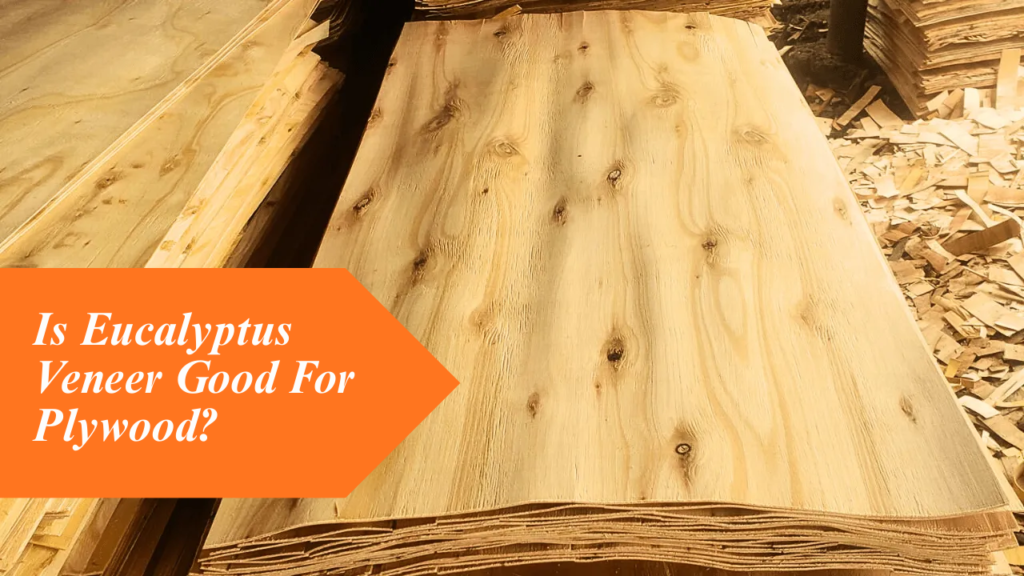
If you work in plywood manufacturing, this question comes up often: Is eucalyptus veneer actually a good choice for plywood? The short answer is yes, but only when you understand where it performs well and what needs attention during production.
Many manufacturers choose eucalyptus because it is strong, widely available, and suitable for different panel types. It is often used as a core veneer for Plywood because it gives panels a solid internal structure. At the same time, it is not a magic material. Like any veneer, it needs proper grading, drying, thickness control, and bonding discipline.
This is where many discussions go wrong. People ask whether eucalyptus core veneer is good or bad, as if there is one simple answer for every factory and every product. In reality, the answer depends on the panel you are making, the quality of the logs, the way the veneer is processed, and the standards expected in the final board.
This blog covers strength, density, bonding, common problems, and practical use in plywood production. The goal is to help readers understand where eucalyptus wood veneer performs well and where extra care is needed.
What Eucalyptus Veneer Really Means In Plywood
In plywood manufacturing, veneer is the thin wood sheet used to build the panel layer by layer. Some sheets are used on the face and back for appearance. Other sheets go inside the board and form the structure. Those inner layers matter a lot because they affect strength, stability, weight, and bond quality.
When people talk about eucalyptus veneer, they usually mean veneer peeled from eucalyptus logs and used either in the core or, in some cases, on outer layers. In most practical discussions, it is mainly considered the core veneer for Plywood.
That makes sense because the core does the heavy work. It holds the board together from the inside. If the core veneer is poor, the final panel may have gaps, weak bonding, uneven thickness, or lower strength. So the real question is not only whether eucalyptus looks good on paper. The real question is whether it performs well inside the board during production and after use.
Why Manufacturers Use Eucalyptus Core Veneer
There is a reason eucalyptus core veneer is common in plywood production. It offers a practical mix of strength, supply, and value.
One major advantage is strength. Eucalyptus is usually stronger than lighter species often used in low-weight panels. That added strength can help when the plywood needs better load-bearing performance or better screw holding.
Another reason is supply. In many regions, eucalyptus is grown in plantation systems and is available in large volumes. That makes it easier for manufacturers to plan production and maintain a steady raw material flow.
It is also versatile. Eucalyptus veneer can be used in furniture plywood, commercial plywood, packing panels, and some structural applications, depending on grade and manufacturing quality.
In simple terms, manufacturers use it because it is practical. It is not chosen only because it is available. It is chosen because it can produce a solid board when the veneer is prepared and laid up correctly.
Strength And Density Matter In The Core
The core layers of plywood affect how the board behaves in daily use. They influence internal strength, resistance to bending, screw holding, and panel stability. That is why density matters when choosing Core Veneer for Plywood.
Eucalyptus wood veneer is usually denser than very light core materials such as poplar. That extra density can be useful. It can improve mechanical strength and give the board a more solid feel. It can also support better holding power for screws and fittings in many furniture and interior uses.
But density also brings responsibility. A denser veneer may behave differently during drying and pressing. If moisture control is poor or the glue spread is weak, the result may not be as good as expected. So the benefit of density only appears when the process is controlled properly.
This is the important point. Eucalyptus core veneer can support stronger plywood, but only when the manufacturing process respects the material.
Bonding Performance Is A Key Part Of The Answer
A veneer can be strong and still create production problems if the bonding is poor. That is why any serious answer about eucalyptus veneer must include glue performance.
Bonding depends on several factors:
- Veneer moisture
- Surface condition
- Thickness uniformity
- Glue spread
- Press temperature
- Press time
- Veneer density
Eucalyptus can bond well, but it needs proper preparation. If the veneer is too wet, the glue line may weaken. If the thickness varies too much, pressure becomes uneven. If the surface has checks, dust, or rough patches, bonding can suffer.
This is one reason some factories get excellent results with eucalyptus veneer, while others complain about inconsistent panels. The difference is often not the species alone. The difference is process control.
So, is eucalyptus veneer good for plywood? Yes, from a bonding point of view, it can be. But it rewards disciplined production more than careless production.
What Makes Good Eucalyptus Veneer
Not all veneer coming from eucalyptus logs performs the same way. Good raw material selection still matters.
A good eucalyptus core veneer should have:
- Reasonably uniform thickness
- Acceptable moisture level
- Limited splits and checks
- Good lay-flat condition
- Clean surface for adhesive contact
- Minimal decay or weak spots
If the veneer is full of defects, the plywood will show it later. The defects may appear as core gaps, overlap, telegraphing, weak spots, or delamination. This is why grading is so important. A cheaper veneer that creates more repair, rejection, or customer complaints is not actually cheaper in the long run.
This is especially true when manufacturers want dependable Core Veneer for Plywood rather than just low raw material cost.
Where Tanzania Eucalyptus Veneer Fits In
In recent years, Tanzania eucalyptus veneer has become a familiar term in the plywood trade. That is because Tanzania has become an important source of plantation-grown eucalyptus used for veneer production.
Factories and traders often pay attention to Tanzania eucalyptus veneer because supply consistency matters. When veneer comes from plantation sources with manageable log size and regular harvesting patterns, buyers often find it easier to plan production.
Of course, origin alone does not guarantee quality. Good and poor veneer can come from any region. But when people mention Tanzania eucalyptus veneer, they are often referring to a supply stream that has become relevant in the market for plywood raw material.
For manufacturers, the useful question is not just where the veneer came from. The useful question is whether the sheets are suitable for the product being made.
So, Is Eucalyptus Veneer Good For Plywood?
Yes, in most practical manufacturing situations, eucalyptus veneer is a good material for plywood. It is strong, available, and well-suited for use as Core Veneer for Plywood. It can help produce durable panels with good internal strength and reliable performance.
But the quality of the final board still depends on more than species alone. Good eucalyptus core veneer needs proper grading, drying, adhesive application, and pressing control. Eucalyptus wood veneer performs best when manufacturers treat it as a technical raw material, not just a commodity sheet.
That is the real answer. Eucalyptus is not perfect, but it is absolutely useful, dependable, and widely accepted when handled the right way. For businesses that want to make smarter plywood material decisions, Kamath Woods can be a helpful place to start the conversation.