

If you’ve ever walked into a timber yard and ordered a 2×4, you probably assumed you’d receive a piece of wood that measures exactly 2 inches by 4 inches. That’s a perfectly reasonable assumption. It’s also wrong — and understanding why can make a real difference in how you plan, purchase, and execute your next project.
This confusion between nominal vs actual timber sizes trips up builders, contractors, and first-time buyers across India every single day. It’s not a scam, and it’s not carelessness on the part of suppliers. It’s a system with historical roots that has stuck around long after the original reason for it stopped being relevant. Once you understand how it works, you’ll never over-order, miscalculate, or be caught off-guard on a job site again.
Where the Confusion Starts
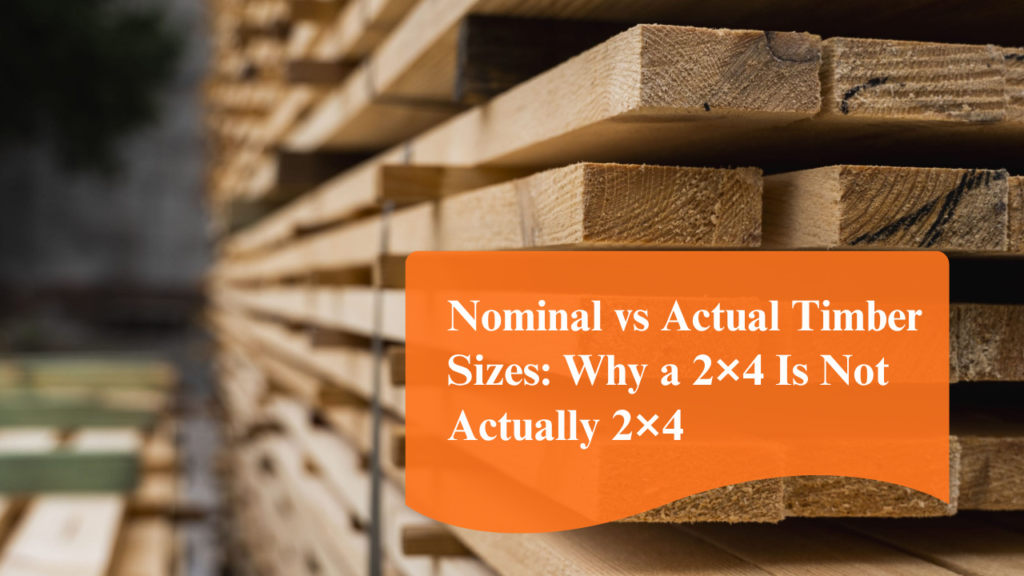
The term “nominal” simply means “in name only.” A nominal 2×4 is called a 2×4 because that’s the name given to that size of timber — not because it actually measures 2 inches by 4 inches at the point of sale.
Here’s what actually happens: timber is cut from logs at rough, green dimensions. At this stage, a 2×4 might genuinely be close to 2 inches by 4 inches. But then it gets dried — either air-dried or kiln-dried — and the wood shrinks. After that, the faces are planed and surfaced to create smooth, consistent edges. That process removes more material. By the time a piece of timber reaches the yard or the job site, it’s noticeably smaller than its nominal label suggests.
This is not unique to any one country or supplier. It’s an industry-wide convention that exists across markets, including India, where timber is commonly traded using nominal dimensions borrowed from international labelling systems.
The Real Numbers Behind Common Wood Board Dimensions
Let’s look at some of the most commonly ordered sizes and what they actually measure once processed:
A nominal 2×4 — probably the most widely recognised timber size in construction — has an actual size of approximately 1.5 inches × 3.5 inches. That’s a reduction of half an inch on both dimensions.
A 2×6 comes in at around 1.5 inches × 5.5 inches in actual size.
A 2×3 measures closer to 1.5 inches × 2.5 inches.
A 4×4 post, often used for structural columns and frames, actually measures roughly 3.5 inches × 3.5 inches.
For buyers used to working in millimetres, the effect is the same — nominal dimensions listed in inches or centimetres will be larger than what you physically receive. The gap exists because of the drying and surfacing process, and it’s consistent and predictable once you know the standard reductions involved.
Why This Matters More Than People Think
At first glance, half an inch doesn’t sound like much. But consider a framing project where you’re spacing studs across a 20-foot wall. If your calculations are based on nominal 2×4 dimensions rather than actual 2×4 actual size, every joint, bracket, panel, and fixing point is slightly off. Those small gaps compound into real structural problems — or at minimum, a lot of rework.
In furniture making, the difference is even more pronounced. A bookshelf designed around nominal wood board dimensions will have shelves that don’t sit flush, gaps where clean joinery was expected, and a finished product that looks off even if you can’t immediately identify why.
For timber for residential and commercial construction, this distinction is critical at every stage — from structural calculations to finish carpentry. Engineers and architects working on commercial builds are typically aware of actual dimensions and specify accordingly. But on smaller residential projects and DIY builds, this knowledge gap is where a lot of preventable errors occur.
Nominal Sizes in the Indian Context
India presents its own layer of complexity here. The country uses a mix of measurement systems — metric and imperial — and timber is often sold using inch-based nominal labels (like 2×4, 3×4, 2×6) even though final dimensions may vary slightly between suppliers based on how the timber was processed.
Imported timber — particularly East African pine, which is widely used across India for construction framing and packaging — is typically sold using these nominal inch designations. But the actual dimensions after drying and surfacing follow the same international convention: smaller than the name suggests.
This is why, when procuring timber wood for any project, it’s always worth asking your supplier to confirm the actual finished dimensions, not just the nominal label. A reliable supplier will have no hesitation in providing this information upfront.
The Role of Timber Grades in This Picture
Nominal dimensions tell you the size name. Timber grades tell you what the wood is actually like once you have it in hand.
A Grade A 2×4 and a Grade B 2×4 will have the same nominal — and roughly the same actual — dimensions. What differs is the quality of the wood itself: the number and size of knots, the grain consistency, the moisture content, and the surface finish. Grade A material will be cleaner, more consistent, and better suited to visible or structural applications. Grade B is perfectly functional for general framing and industrial use, at a lower price point.
Understanding both — nominal vs actual size, and grade — gives you the full picture of what you’re buying. Size tells you the geometry; grade tells you the quality. You need both to make a well-informed purchase decision.
Surfaced vs Rough-Sawn Timber: Another Layer
It’s also worth knowing that not all timber is surfaced to the same degree. Rough-sawn timber is cut at the mill and sold without further planning. It will be closer to its nominal dimensions but will have uneven, splintery faces and inconsistent measurements from piece to piece.
Surfaced timber (S2S — surfaced two sides, or S4S — surfaced four sides) has been planed smooth, giving you cleaner dimensions, better consistency, and a ready-to-use finish. This is the timber where the nominal-to-actual gap is most pronounced — because planing removes material — but it’s also the more reliable and workable product for most applications.
For construction and interior use, surfaced timber is generally the right choice. For rough framing or packaging where precision is less critical, rough-sawn or partially processed timber offers a cost advantage.
How to Avoid Costly Mistakes on Your Next Purchase
The fix is straightforward once you know the issue exists. Before placing any timber order, confirm the actual dimensions with your supplier — not just the nominal size. Get this in writing if the order is large enough to matter. Factor actual dimensions into your design and engineering calculations from the start, not after the material arrives.
If you’re working with a contractor or fabricator who is drawing up plans, make sure they’re using actual timber sizes in their measurements. Many experienced builders do this automatically. Others, particularly those newer to the trade, may default to nominal sizes and create problems downstream.
At Kamath Woods, timber is available across standard nominal sizes — 2×3, 2×4, 2×6, 3×3, 3×4, 4×4, in standard lengths of 8, 12, 13, 16, and 18 feet — with transparent communication about actual finished dimensions based on the grade and processing type selected. The goal is always that buyers have the information they need before the material leaves the yard, not after it arrives on site.
The Bottom Line
A 2×4 is not actually 2×4. A 4×4 post is not 4 inches on each side. This is not a defect in the system — it’s the system, and it’s been this way for decades. What matters is that you understand it before you buy, not after you’ve already cut everything to size.
Nominal vs actual timber sizes is one of those fundamentals that experienced buyers know intuitively and newer buyers learn the hard way. Now you don’t have to.
Know your nominal, confirm your actual, match your grade to your application — and your next timber purchase will go exactly as planned.