

Why Does Wood Warp, Bow or Bend?
Why Does Wood Warp, Bow or Bend?
Understanding Wood Warping, Moisture Effects, and East African Timber
Wood warping is a natural phenomenon affecting timber worldwide, yet many builders, furniture producers, exporters, and timber buyers find it challenging to understand. Wood is a widely used natural building material, but issues such as warping, bowing, bending, twisting, and cupping remain challenging for professionals across the industry.
A lot of people think that “bad quality wood” causes these problems. But in reality, wood warping is a natural and predictable process controlled by factors such as moisture content, grain structure, wood species, and drying methods.
This post explains the primary reasons why wood warping occurs. We’ll focus on East African timber species and how softwoods like pine behave in different settings.
What Is Wood Warping? Types of Wood Movement
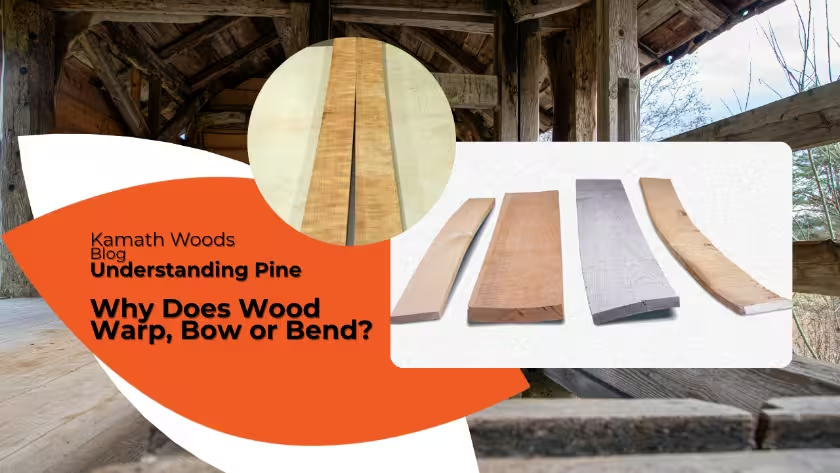
When someone says that wood has warped, they mean it has changed shape so the board is no longer straight and true. Wood warping can manifest in several distinct ways:
- Bow: The board bends along its length, creating a soft arch from one end to the other.
- Crook: The edge of the board curves, creating a “C” shape along one side instead of a straight line.
- Cup: The board’s edges lift up or dip down compared to the middle, forming a shallow “U” or “hill” shape across the width.
- Twist: The board appears twisted, with corners no longer flat in the same plane.
- Kink: An abrupt, localized bend or bump appears at one spot instead of a smooth curve.
The wood isn’t broken; these changes are how timber responds to moisture stress and environmental conditions.
Moisture Movement: The Primary Cause of Wood Warping
Wood is hygroscopic, meaning it continuously absorbs and releases moisture from the surrounding air. Even after being cut, sawed, and dried, wood still reacts to humidity variations (Simpson & Forsman, 1983).
The fundamental principle:
• When wood dries out, it shrinks
• When wood absorbs moisture, it expands
The crucial factor: wood does not shrink or expand evenly in all directions.
Wood warping occurs when timber shrinks unevenly.
Understanding directional wood movement:
- Longitudinal (lengthwise) – minimal movement occurs
- Radial (across growth rings) – moderate movement
- Tangential (along growth rings) – maximum movement occurs
These unequal movements create internal stresses that cause boards to bend, twist, or cup: The classic signs of wood warping.
Drying Methods and Wood Warping Prevention
Your drying method is crucial for preventing wood warping. Uneven drying is the main cause of wood warping in timber products.
When wood warping is most likely to occur:
- One side of the board dries faster than the other
- Outer layers dry faster than inner layers
- Sun, wind, and heat exposure varies across board surfaces
This is especially important for air-dried wood, which is common in East Africa.
Air Drying vs. Kiln Drying for Wood Warping Prevention
• Air drying is slower and less expensive, but improper techniques can cause wood warping and inconsistent moisture content.
• Kiln drying allows precise control of temperature, humidity, and airflow, reducing internal stress and minimising wood warping.
Wood warping isn’t specific to pine or African species; it results from improper or incomplete drying processes.
How East African Climate Affects Wood Warping
East Africa’s diverse climate, from humid coastal areas to arid savannas and cool highlands, creates significant seasonal moisture variations that increase wood warping risk.
Common challenges that cause wood warping in East Africa:
- High humidity during rainy seasons
- Rapid surface drying in hot, dry conditions
- Inadequate airflow or improper stacking during storage
If you dry or store wood without considering these climate factors, uneven moisture content will cause wood warping.
Pine Timber and Wood Warping in East Africa
Pine is the most abundant softwood in East Africa, and understanding its characteristics is essential for preventing wood warping.
Plantation-grown pine species like Pinus patula, Pinus radiata, and Pinus caribaea are widely used across:
- ✓ Tanzania
- ✓ Kenya
- ✓ Uganda
- ✓ Rwanda
Common applications for East African pine:
- Construction timber
- Pallets and packaging
- Furniture frames
- Export timber products
Many people claim pine is “unstable,” but its wood warping behavior is more complex than that perception suggests.
Pine characteristics that influence wood warping:
- Rapid growth rate
- High initial moisture content
- Lower density compared to hardwoods
- Quick response to moisture changes
These characteristics make pine more susceptible to wood warping when dried improperly, but don’t indicate inferior quality.
When pine is properly processed to prevent wood warping:
• Stacked with proper spacing
• Dried gradually and evenly
• Kiln dried to appropriate moisture content
It performs as well as European, Scandinavian, or North American pine.
Sawing methods and wood warping susceptibility:
Most East African pine is flat-sawn, which means:
- Maximum yield from each log
- Higher susceptibility to wood warping (bending and cupping)
Quarter-sawn pine offers better dimensional stability and resists wood warping more effectively, but yields less usable timber.
Plantation growth effects on wood warping:
Fast plantation expansion can lead to:
- Wider growth rings
- Increased tangential shrinkage
- Greater wood warping risk if drying is too aggressive
Pine itself isn’t problematic. It’s improper handling that causes wood warping issues.
Common Mistakes That Cause Wood Warping in East African Pine
The most common errors that lead to wood warping include:
- Direct sun exposure during drying
- Insufficient spacing between boards
- Lack of stickers or weights during air drying
- Using wood before reaching proper moisture content
- Moving dried wood to different climates without acclimatization
Most wood warping complaints, especially with softwoods, stem from these preventable factors.
Best Practices to Prevent Wood Warping
You can significantly reduce wood warping risk by:
- Using controlled drying methods, combining air and kiln drying when possible
- Placing spacers (stickers) between boards for uniform airflow
- Controlling drying rate to prevent rapid moisture loss
- Allowing wood to acclimate to its final environment before use
- Matching moisture content to the intended location and climate
This is especially critical for timber exports. Pine dried for East African conditions may require additional conditioning before use in colder or drier climates to prevent wood warping.
Understanding and Controlling Wood Warping
Even after harvest, wood continues reacting to environmental conditions. Wood warping results from the interaction of grain direction, moisture movement, species characteristics, and climate.
Key takeaways about wood warping in East Africa:
- Both softwoods and hardwoods are susceptible to wood warping
- Pine isn’t inferior; it simply requires proper processing to prevent warping
- Wood warping is predictable and preventable with correct handling
When East African pine is dried and handled correctly, wood warping becomes minimal, and the timber performs just as well as pine from Sweden, Europe, or North America. This softwood is dependable, long-lasting, and valuable when processed with care.
For more information about our timber processing methods or to discuss how you can prevent wood warping in your products, reach out to us for more.