

If you’ve ever stood at a timber yard in Bengaluru, Mumbai, or anywhere across India trying to figure out exactly how much wood you need — and whether the price per cubic foot adds up — you’re not alone. Calculating timber volume correctly is one of those practical skills that every contractor, carpenter, and self-builder needs, yet very few people sit down and actually learn it properly. The result? Over-ordering that eats into budgets, under-ordering that stalls projects, or simply getting overcharged because the numbers weren’t verified.
This guide walks you through how to calculate timber volume in both cubic feet (CFT) and cubic metres (CBM), with practical examples suited to Indian construction contexts — from roofing and framing to doors, window frames, and furniture work.
Why Timber Volume Calculation Matters
Timber is commonly bought and sold by volume — cubic feet or cubic metre, depending on the supplier and region — and by knowing how to calculate your own volume will give you a good idea of what materials you will actually be paying for, as well as providing a way of comparing quotes from suppliers and avoiding waste.
This is particularly useful for builders or contractors working with construction and/or structural timber, where there is usually a higher degree of risk associated with construction.
When completing large residential home builds or large commercial building projects, even minor errors can greatly affect the cost of a job. Therefore, knowing how to convert volume into cubic metres is fairly easy to do on paper; however, the true difference between a successful builder and an unsuccessful builder will be whether or not they know how to consistently apply that conversion formula when estimating costs.
The Basic Formula: How to Calculate CFT of Wood
Cubic feet (CFT) is the most commonly used unit for timber measurement at Indian timber yards. The formula is simple:
Core Formula — Cubic Feet
Volume (CFT) = Length (ft) × Width (ft) × Thickness (ft)
All three dimensions must be converted to feet before multiplying. If measurements are in inches, divide each value by 12 first.
For example, if you have a timber plank that is 10 feet long, 6 inches wide, and 1 inch thick, you’d convert the width and thickness to feet first: 6 inches ÷ 12 = 0.5 ft, and 1 inch ÷ 12 = 0.083 ft. The volume would then be: 10 × 0.5 × 0.083 = 0.415 CFT.
Now multiply that by the number of pieces you need, and you have your total timber volume to order. Easy enough — but where many people slip up is forgetting to convert units consistently, or mixing inches with centimetres mid-calculation.
How to Calculate Timber Volume in CBM
CBM, or cubic metres, is the standard unit for international timber imports and is increasingly used by larger suppliers in India. The formula follows the same logic:
Core Formula — Cubic Metres (CBM)
Volume (CBM) = Length (m) × Width (m) × Thickness (m)
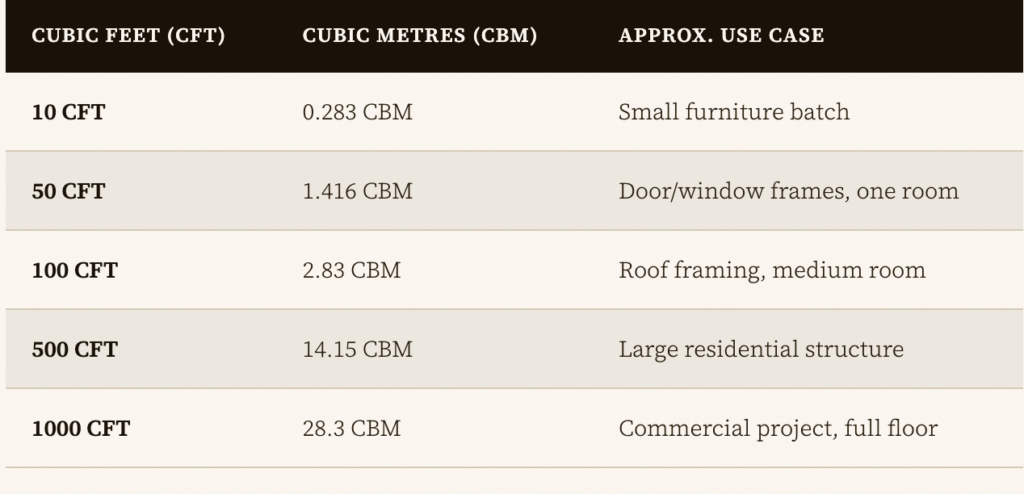
Convert all measurements to metres. 1 CFT = 0.0283 CBM. 1 CBM = 35.315 CFT. Use these conversion factors to switch between units as needed.
For imported hardwoods or large bulk orders, timber is often quoted in CBM. Knowing both units and the conversion between them gives you the flexibility to work with any supplier, domestic or international.
A Practical Timber Volume Calculator Approach
Instead of simply using a digital timber-Volume calculator, having an understanding of the Manual procedures will help you detect mistakes and adjust for pieces that come in various shapes and sizes. The following is an easy-to-apply, on-site process to calculate timber volume:
Step 1: Separate Measurements for Each Bunch
Never assume that your bunch contains identical pieces! Take measurements on a representative number of each piece and document any differences, as slight differences in width and thickness of sawn timber is expected to add up to significant differences when taken cumulatively across an entire order.
Step 2: All Measurements Should Be in Same Units of Measure (Either Imperial or Metric)
Choose either feet or metric and be consistent. Much of the work performed by local carpenters and contractors in India is performed using imperial units, so cubic feet will generally work best for day-to-day usage.
Step 3: Calculate Volume of Individual Piece Before Totalling
To calculate the volume of each piece, multiply length x width x thickness and then multiply that by the number of pieces required (i.e. length x width x thickness = volume of individual pieces). This way, you will have simple calculations to check on the total and check on individual line items.
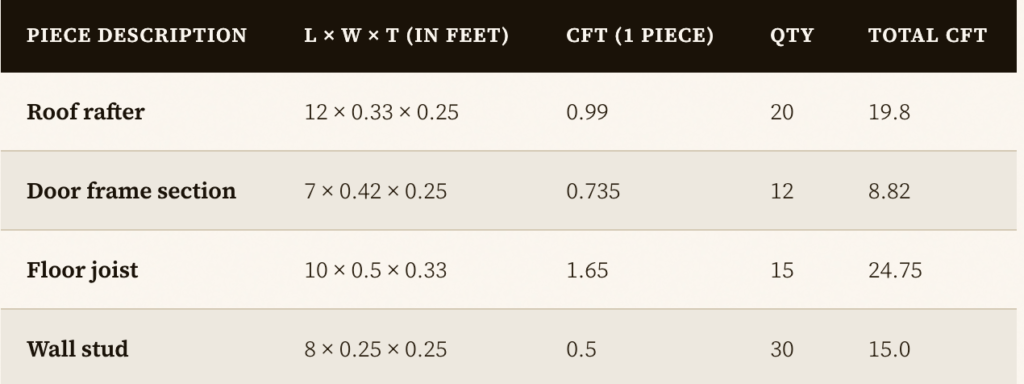
Adding 10–15% to your calculated volume as a wastage buffer is standard practice in Indian construction — accounting for cutting losses, defects, and last-minute design changes.
Round Logs vs. Sawn Timber: Does the Formula Change?
If you’re working with sawn timber such as boards, beams and battens, you can use the rectangular formula found above. If you’re sourcing locally from forests or using round logs for rustic applications, the formula will vary slightly. You will typically use a mid-girth formula (circumference at log’s mid-point): use the circumference to calculate the mean diameter of one-half of it and then apply that diameter value to create your new base for measurement. On the other hand, most urban projects in India are constructed using sawn and processed timber, so in these situations, the basic CFT formula would be frequently used.
If you’re selecting timber for a specific structural purpose, understanding the species, grade, and treatment is just as important as volume. Structural timber has its own strength grades and application guidelines that affect how much material you actually need for safe, load-bearing construction.
Common Mistakes to Avoid
One of the most frequent errors is calculating timber volume based on nominal dimensions rather than actual dimensions. A “2×4” (two by four) piece of timber is rarely exactly 2 inches by 4 inches after dressing and seasoning — it’s usually closer to 1.5 × 3.5 inches. Always verify actual dimensions before calculating, especially for finish carpentry where precision matters.
Another common pitfall: forgetting to account for wastage. Whether due to knots, cutting tolerances, or design changes mid-project, adding a buffer of 10–15% to your total calculated volume is standard practice. For premium or imported timber where costs are higher, even a modest wastage allowance makes financial sense.
Pro Tip — Ordering for a Full Build
When estimating timber for a full residential project, calculate room by room rather than totalling everything at once. This makes it easier to prioritise phases of procurement, reduces storage pressure on site, and helps you adjust quantities if design changes occur mid-build.
Choosing the Right Timber Before You Calculate
Calculating the total volume of timber you’ll need doesn’t get you very far if you don’t also know what type of timber is best suited for your project. Not all woods are appropriate for either structural use, being exposed to the elements, or being in a highly humid environment. Whether you’re building an addition on your small home or constructing a major commercial building; selecting the proper timber depends upon many factors including the load to be supported, the climate, and the quality of finish to meet your design intent.
Similarly, if you’re still in the planning stages and haven’t settled on a species or grade yet, a practical approach to choosing the right timber can save a significant amount of time and money — before the volume calculation even begins.
Quick Reference: CFT to CBM Conversions
Bringing It All Together
Calculating timber volume — whether in cubic feet or CBM — is a foundational skill that pays dividends across every kind of construction project. The math itself is not complicated; the discipline is in measuring accurately, converting units consistently, and adding a sensible wastage buffer before placing your order. Once this becomes second nature, you’ll find yourself making faster, more confident procurement decisions — and fewer costly mistakes at the timber yard.
Whether you’re framing a roof, building out a commercial interior, or simply replacing a few structural members, the volume calculation process remains the same. Master it once, and it stays with you through every project that follows.