

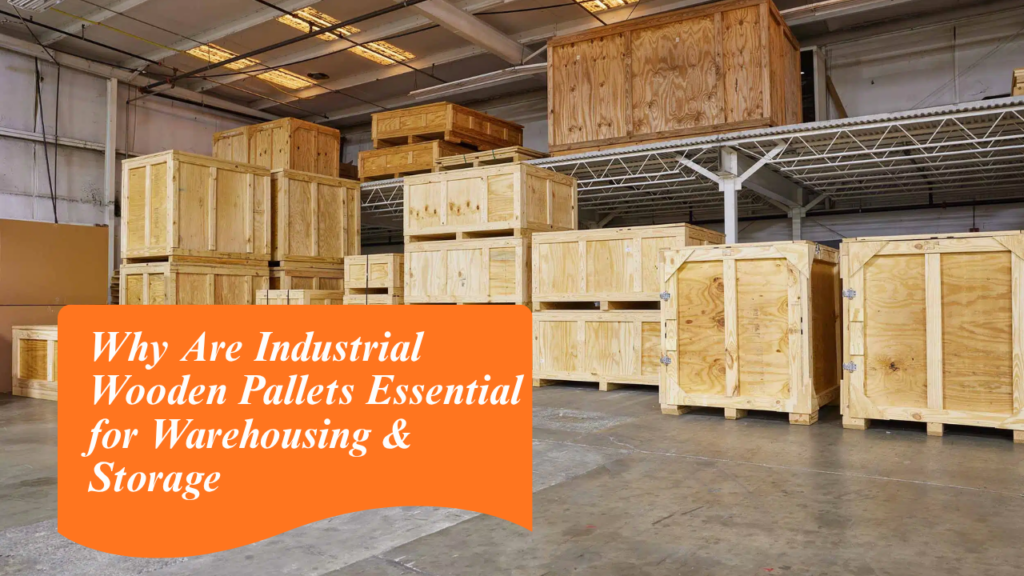
Walk into any warehouse in India — whether it’s storing automotive parts, pharmaceutical goods, or FMCG products— and you’ll find wooden pallets stacked everywhere. They sit quietly at the base of every operation, holding tonnes of goods, yet rarely get the attention they deserve.
So why do warehouses across industries keep going back to industrial wooden pallets? And why, despite the rise of plastic and metal alternatives, do they remain the backbone of storage and logistics in India and globally? Let’s get into it.
What Is a Pallet, Really?
A pallet is a level, structural surface that is used in storing goods and transportation. It enables forklifts, pallet jacks and other handling equipment to move and lift loads effectively. That is the basic task – however, pallets do not just sit on the floor.
In a warehouse setting, pallets create the foundation for racking systems, enable vertical stacking, protect goods from ground moisture, and allow fast movement of bulk cargo. Without them, warehousing as we know it wouldn’t work. The entire architecture of modern logistics is built around the pallet.
Standard Pallet Dimensions — Why They Matter
One of the most underappreciated aspects of industrial pallets is how standardisation drives efficiency across the supply chain.
In India and across most of Asia, the most commonly used standard pallet dimensions are 1000mm × 1200mm, with a height of around 150mm. This size aligns well with container dimensions, truck bed widths, and warehouse racking systems. When your pallets match the infrastructure, loading becomes faster, space utilisation improves, and the risk of cargo shift during transit drops significantly.
Internationally, standard wood pallet dimensions vary slightly by region. The EUR/EPAL pallet (used heavily in Europe) measures 800mm × 1200mm, while the GMA (Grocery Manufacturers Association) pallet common in North America is 48″ × 40″ — roughly 1219mm × 1016mm. If your business handles export, knowing which standard applies to your destination market matters a great deal.
At Kamath Woods, we manufacture pallets in standard sizes including 1000×1200×150mm, as well as EPAL-sized and GMA pallets — because different customers have different supply chains, and a pallet that doesn’t fit the system is a liability, not an asset.
Why Only Wooden Pallets Specifically?
This is where things get interesting. Plastic and metal pallets exist. So do presswood and paper pallets. But wooden pallets remain the dominant choice for industrial storage — and for good reason.
- They are robust and capable of bearing weight: A good industrial wooden pallet can comfortably carry dynamic loads of 1 000 kg and heavy loads of much higher values. In the case of heavy objects such as machinery parts, chemical drums or building materials, wood offers the structural integrity that most other alternatives cannot offer at a similar price.
- They can be repaired: This is monumental: In case one deck board of a wooden pallet breaks, you substitute that board. Damage on plastic or metal pallets usually translates to scraping the whole unit. The ability to repair wooden pallets increases the life cycle of the pallets and saves money in the long run.
- They are economical at scale: Wooden pallets make cost sense in the high-volume warehousing and logistics in India. They cost less to acquire, less expensive to fix, and at end-of-life, the wood can be used in other ways as residual value, it can be recycled, re-purposed, or chipped.
- They are easy to hold: Wood is natural and offers a level of friction thus goods have less chances of moving during transportation as opposed to smooth surfaces that are plainly plastic.
The Export Factor — ISPM-15 and Why It’s Non-Negotiable
If your warehouse operations include export — whether by sea or air — then the compliance dimension of wooden pallets becomes critical.
Under international phytosanitary regulations, raw wood packaging materials crossing borders must be treated to prevent the spread of pests and pathogens. This is governed by the ISPM-15 standard, which mandates heat treatment (HT) or methyl bromide (MB) treatment for all wooden pallets used in international trade.
Choosing the right wood for export pallets — particularly a species that responds well to heat treatment — is therefore not just a quality decision, it’s a compliance one. Pine wood, especially East African pine, is widely used for export-grade pallets precisely because it heat-treats effectively and consistently.
At Kamath Woods, our pallets are manufactured from sustainably sourced East African pine and are available with ISPM-15 heat treatment and proper HT markings. This ensures your shipments clear customs without delays.
For a detailed breakdown of what ISPM-15 compliance involves and why it matters, refer to our complete guide on ISPM-15 heat treatment.
How Pallets Optimise Warehouse Operations
Let’s talk practically. A warehouse that uses standardised industrial pallets — and uses them correctly — gains in several specific ways:
- Vertical space utilisation: Pallets sit on racking, and racking goes up. A 10,000 sq ft warehouse with good racking and standard pallets stores dramatically more than the same warehouse with goods stacked directly on the floor. Pallets are what make racking possible.
- Faster loading and unloading: A forklift can move a fully loaded pallet in seconds. Without pallets, the same goods would require manual handling — slower, more labour-intensive, and riskier for goods and workers alike.
- Inventory control: Standardised pallets make SKU-level inventory management easier. Each pallet load becomes a unit of inventory, which simplifies counting, tracking, and dispatch.
- Damage reduction: Goods on pallets are elevated off the ground, protected from moisture, and less prone to damage from handling. For industries dealing with sensitive goods — electronics, chemicals, food products — this matters enormously.
Choosing the Right Pallet for Your Warehouse
Not all pallets are built the same. The right choice depends on your application, load requirements, and whether the goods are meant for domestic storage or export.
2-way entry vs 4-way entry pallets- 4-way entry pallets enable the forklift entry on either side; and this is fast in a narrow warehouse environment. 2-way pallets are easier and usually applied in light duty cases.
The chemical pallets were developed to operate drums and containers with hazardous or liquid products, with particular shapes of the loading.
Custom sizing- although standard sizes are effective in most operations, there are warehouses or manufacturing layouts which demand custom pallet size to fit a certain racking layout or cargo profile.
Always talk to your pallet manufacturer about your load needs and warehouse layout when you are in doubt before ordering. Even a misplaced pallet generates inefficiencies that multiply thousands of times.
Final Thoughts
Industrial wooden pallets aren’t glamorous. They sit at the floor level of every warehouse, bearing the weight of goods, supply chains, and logistics operations quietly and consistently.
But they’re essential — not because there’s no alternative, but because they solve the core problems of warehousing better than most alternatives, at a scale and cost that makes sense for Indian industry.
Standard dimensions, reliable load capacity, repairability, compliance for export — when you add it all up, the wooden pallet remains one of the most sensible and proven tools in industrial storage and logistics.
If you’re sourcing pallets for warehousing, manufacturing, or export — whether standard sizes or custom builds —Kamath Woods manufactures ISPM-15 compliant pine wood pallets from our facility in Bangalore. Reach out to discuss your requirements.
Frequently Asked Questions
1. What is a pallet used for in a warehouse?
A pallet is a flat platform used to store, stack, and move goods easily with forklifts or pallet jacks, improving efficiency and protecting products in the warehouse.
2. How much weight can a wooden pallet hold?
A standard wooden pallet can typically hold 1,000 to 1,500 kg (2,200–3,300 lbs) dynamically and up to 2,500 kg (5,500 lbs) when evenly distributed, depending on pallet quality and design.
3. Why are wooden pallets preferred over plastic or metal?
Wooden pallets are preferred because they are cost-effective, strong, easy to repair, and widely available. They also provide good load support, can be recycled, and are suitable for most storage and shipping needs.
4. Do wooden pallets help in safe material handling?
Yes, they allow goods to be moved safely using forklifts and pallet jacks, reducing manual effort and risk of damage.
5. What sizes do wooden pallets come in?
Wooden pallets are available in standard and custom sizes to suit different storage and shipping requirements